
Growth Strategies — How Good Is Your Pro Forma?
Having spent time on both the tenant side, at the operations and corporate levels, and on the brokerage side as a tenant rep; it has given me a 360′ view of the inherent transactional levers that drive both sides of a real estate transaction. The economic drivers that motivate a restaurant to index what could be a viable site has to line up with the economic drivers that motivate an owner to lease a space within the asset. One example of a driver for a restaurant could be an occupancy cost, as a percentage of sales, that fall within a range based on the revenue projection for that specific site. Conversely, a driver for the landlord most typically could be the need to have a credited tenant, at market rates, for stabilization to maximize resale value of the overall asset. Pro Forma or Argus models are the most common tools used to compare and contrast business cases in order to make informed decisions on an investment.
For restaurant and retail concepts deliberating on new sites, building economic models to evaluate those sites is a crucial piece of information to help make a decision on whether the site will be viable. Even though the Return On Invested Capital (or “ROIC”) formula may seem straightforward, the accuracy of the data below the variables is where the true complexity lies.

Let’s start with understanding the base set formula outline above. First make sure you understand the variables of the ROIC calculation. Investment, Projected Revenue, and Projected Expenses. If I were to write out the ROIC formula in a mathematical sentence it would be (Projected Revenue — Projected Expenses) / Invested Capital = ROIC at a given period in time. There are several other variables (Tax rate, Asset Depreciation, Present Value of the Lease) that factor into the calculation subject to the alignment of your respective business needs. The objective for the investment, is for your ROIC percentage to be greater than your Weighted Average Cost of Capital (or “WACC”). In other words, capital investment is returning a higher rate than the cost of borrowed capital.
The example below illustrates how to build the model in Excel. Reflecting a 20% Return on Invested Capital at a given point in time.
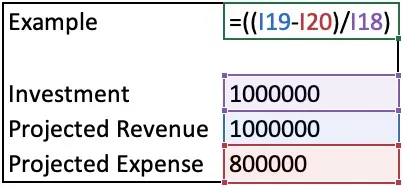

The level of precision depends on how up to date and accurate the data tables are for your variable inputs. Reliability in a model starts with the accuracy of data. The data below each variable (Investment, Projected Revenue, and Projected Expense) of the calculation is critical to returning an accurate solution to the equation. Just like any analysis, the end result is only as good as the quality of data used for the research.
Again, the true complexity is not calculating the formula. It is having the experience and well rounded understanding of the data that make up the formula, in order for you to make the most informed decision for that investment.
Here are a few tips for validating your data, which should return the best overall outcome to your ROIC calculation.
Have a complete and detailed P&L for your Revenue and Expense Projections. Make sure your are accounting for all of your sales channels (Food by sales category, Alcohol by sales category, 3rd Party Delivery, Merchandise, Etc.) and equally or more important, all your expense categories (Food Cost, Labor, Supplies, Admin, 3rd Party Delivery, Etc.). Using an existing location in the market is a great baseline to start with.
Use qualified sources of data to build your data tables for each variable. Do you have existing sales and expense data from other sites in the market? If it is a new market; can you leverage data from your concept in another similar market? If this is a brand new concept, use industry benchmarks.
Do you have a very recent cost schedule (soft and hard costs) for the total investment? Construction costs are a moving target these days. Make sure you are working with a reputable development company, architect, and GC to get the most up to date and accurate cost for the project.
Triangulate and verify each data point with additional sources that are outside of your initial sources. Leverage your network to triangulate your revenue and expense projections against other concepts in the market. They don’t have to give you intimate details of their business; but percentage of sales, percentage of expenses, and margins can be easily shared. As long as they are not a direct competitor, most people in the restaurant industry love helping other concepts in the industry.
Ask your trusted circle of partners and advisors to verify your assumptions, and validate the data tables below each variable. Surround yourself with people that you trust and that have the experience in the areas that you don’t. Have them question and talk through each data point in order to help validate your assumptions.
Contact me directly to discuss tailoring an execution strategy for your company.
Malik Hammack